Strengthening climate action
© Sonia SEMEDO

In response to the intensification of climate risks in some of its areas of intervention, LuxDev supports integrated approaches that strengthen environmental governance, territorial adaptation and the transition to more sustainable energy models.
A multi-sectoral approach to environmental governance in Cabo Verde
As a small island state, Cabo Verde is particularly vulnerable to the effects of climate change, which threaten communities, ecosystems and essential sectors such as water, agriculture and health. Despite ambitious commitments, limited technical capacity and fragmented coordination continue to hamper the implementation of climate policies.
In this context, the Climate action programme is committed to strengthening the national climate governance system through a multi-sectoral approach. In 2025, it addressed the low level of environmental awareness at the University of Cabo Verde by rolling out an innovative programme combining the training of trainers and climate ambassadors, awareness-raising activities for 1,096 students, the organisation of Olympiads, and the development of scientific and educational tools.
In Mosteiros, on the island of Fogo, where warming and acidification of the waters are driving pelagic species away from the coast, the installation of fish aggregating devices and the promotion of sustainable fishing practices helped to reduce pressure on marine ecosystems, while strengthening the resilience of coastal communities dependent on artisanal fisheries.
Finally, on the island of São Nicolau, the programme contributed to reduce the risk of fire in the Monte Gordo Natural Park. Twenty volunteer firefighters were trained, while local communities were made aware of forest fire alerts and prevention. At the same time, firefighting and protective equipment was procured, and access routes and firebreaks were created to facilitate evacuations and limit the spread of fires. A special forest fire defence plan was also drawn up to ensure the protection of the island’s green lung.

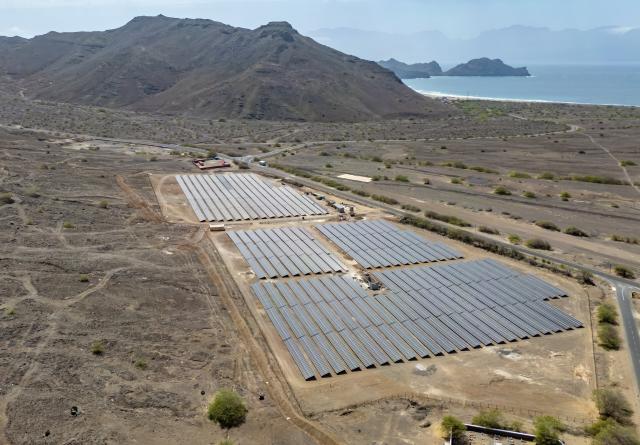
For its part, the Energy transition support programme has the long-term objective of contributing to universal access to clean and affordable energy. Rolled out nationwide, it fosters the sustainable production and distribution of energy, improves infrastructure, promotes energy efficiency and strengthens governance in the sector.
In 2025, the programme undertook major works on the island of Boa Vista, Cabo Verde’s third-largest electricity market and the last of the country’s main electricity systems not yet connected to the centralised control framework. These interventions focused on extending the supervisory control and data acquisition system, which collects real-time information on electricity generation and consumption. They also enabled the integration of Boa Vista into the National Dispatch Centre, responsible for coordinating the balance between electricity supply and demand across the country.
Once the works are completed in 2026, around 90% of Cabo Verde’s electricity market will thus be placed under centralised real-time monitoring. This modernisation creates the technical conditions necessary for more predictive management of island grids, including renewable energy generation and battery storage systems.

Gallery viewer


-
Did you know?
Alongside the Climate action programme, which is designed as Luxembourg’s response to support Cabo Verde in implementing its climate policies and strategies, LuxDev implements three complementary initiatives on behalf of the United Nations, funded by the Green Climate Fund. Two of these focus directly on climate governance.
The first supports the establishment of a coordinated national system bringing together government ministries, local authorities, civil society, businesses and universities, and strengthens the capacity of their members in the planning, implementation and monitoring of climate actions.
The second project links national strategies with local efforts. It supports the development of local climate action plans in 16 municipalities by helping them design solutions tailored to their specific vulnerabilities.
Finally, the third initiative aims to improve the country’s access to climate finance by equipping the Ministry of Finance with the institutional and technical capacity needed to prepare proposals that meet the requirements of the Green Climate Fund, a key factor in the success of Cabo Verde’s climate policies.

-
In execution Cabo Verde
Enabling direct access to the Green Climate Fund for climate finance for Cabo Verde
Environment and climate change
Enabling direct access to the Green Climate Fund for climate finance for Cabo Verde -

In execution Cabo Verde
Strengthening the Cabo Verde climate governance framework
Environment and climate change
Strengthening the Cabo Verde climate governance framework -
In execution Cabo Verde
Cabo Verde’s climate action planning at local level
Environment and climate change
Cabo Verde’s climate action planning at local level


Funding climate resilience in Vietnam
In Vietnam, in the Hue region – which is particularly vulnerable to the effects of climate change – the CARe Hue project, co-financed by the Green Climate Fund and the Grand Duchy of Luxembourg, pursues a threefold objective: strengthening risk-informed decision-making and climate adaptation planning, improving the resilience of ecosystems while supporting vulnerable communities, and scaling up climate-resilient practices through innovative financing mechanisms.
The Finance for resilience project (see "A replicated approach" in the private sector section), implemented on behalf of the Grand Duchy of Luxembourg, is designed to complement the CARe Hue project. It aims to promote climate-smart agriculture while strengthening inclusive financing and market access for nearly 300,000 smallholder farmers and agri-entrepreneurs in the city of Hue. Based on a market systems development approach, the project identified a portfolio of resilient, high-value crops. It then forged partnerships with companies whose business models are based on long-term sustainability and responsible sourcing, in order to secure access to structured markets and strengthen the economic integration of local farmers and artisans.


© TUAN
In 2025, LuxDev partnered with the company Musa Pacta to establish a zero-waste organic banana value chain across some 50 hectares. A total of 250 smallholders will farm their own land under long-term production and purchase agreements. The innovation lies in the use of by-products, notably the processing of banana stems into fibres for crafts and textiles. This circular model helps to diversify income sources, reduce environmental impact and create new opportunities, particularly for women, in processing and artisanal activities.
Across all crops, this approach helped to mobilise EUR 900,000 in private-sector co-investment, complementing the support provided by Luxembourg Development Cooperation. By strengthening value chains that are both environmentally friendly and commercially viable, these partnerships also facilitated access to finance. In December, Agribank disbursed its first agricultural value chain loan to a banana cooperative in the city of Hue, moving beyond collateral-based lending towards credit decisions grounded in secured markets and cash flows.
Gallery viewer


Supporting the energy transition in Kosovo
In Kosovo, the Energy transition and climate mitigation project supports the country’s transition towards a cleaner, more competitive energy sector aligned with European Union standards. It addresses structural challenges such as low uptake of clean energy, limited energy efficiency, constrained institutional capacities and restricted access to green finance. The intervention combines policy support, institutional capacity building and market-based mechanisms.
The project achieved a major milestone in 2025 by supporting the country’s accession to the Association of Issuing Bodies, thereby enabling it to join the European Energy Certification System. As a result, eligible energy producers can access the European market for guarantees of origin and generate additional revenue, while exporting companies benefit from verifiable proof of their use of renewable energy. This development enhances the transparency and credibility of information on the origin of electricity, increases investor confidence and supports the decarbonisation of the private sector.
The year also saw the launch of the Clean Energy Grant Scheme, a grant mechanism implemented by the Kosovo Investment and Enterprise Support Agency, with the Ministry of Economy providing policy leadership. With a budget of EUR 1 million, this scheme supports business investment in solar power, energy storage and energy efficiency, thereby helping to accelerate the adoption of clean solutions by the private sector.

Gallery viewer

